
Pneumatic Cylinders vs Hydraulic Cylinders: Which Should You Use?

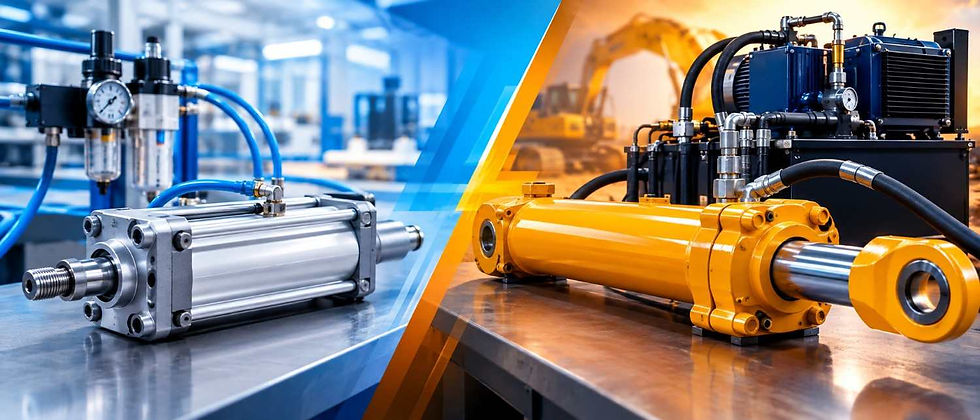
Pneumatic cylinders use compressed air to generate linear motion, making them ideal for light-to-medium force applications that demand speed, cleanliness, and simplicity. Hydraulic cylinders use pressurised fluid to deliver significantly higher force output, suited to heavy-duty industrial tasks. The right choice depends on your force requirements, duty cycle, environment, and system complexity.
If you are an engineer specifying an actuation system, the pneumatic cylinder vs hydraulic cylinder decision is one you will face repeatedly — and getting it wrong has real consequences. Wrong technology means oversized systems, unnecessary costs, and maintenance headaches. This guide gives you a direct, technical comparison to make that call with confidence.
How Each Technology Works
Pneumatic Cylinders
Pneumatic cylinders convert the energy of compressed air, usually supplied at a pressure of 5 to 10 bar, into mechanical force and linear motion. They are either double acting or single acting and the mechanics are simple. Air comes into one side of the piston, the piston moves and exhausted air is vented to atmosphere.
That's because air is compressible and these cylinders are naturally quick and a little forgiving of load changes. In pick-and-place, clamping and assembly automation pneumatics are dominant because cycle times in the millisecond range are possible.
Hydraulic Cylinders
Hydraulic cylinders work with an incompressible fluid (usually mineral oil) at pressures between 70 and 700 bar. This incompressibility translates directly into precise, high-force output with excellent positional stiffness. Hydraulic cylinders are small but produce tens of thousands of newtons of force.
The price is the intricacy of the system. “You need a power pack, a tank, valves, return lines and seals that are rated for high pressure. Any leak is a safety hazard and environmental hazard in the shop floor.
Pneumatic vs Hydraulic Cylinder: Side-by-Side Comparison
Parameter | Pneumatic Cylinder | Hydraulic Cylinder
|
Operating Pressure | 5 – 10 bar | 70 – 700 bar |
Force Output | Low to medium | Very high |
Speed | Very fast (up to 1 m/s+) | Slower, controllable |
Precision | Moderate | High positional stiffness |
Cleanliness | High (no fluid leaks) | Risk of oil contamination |
System Complexity | Low | High |
Energy Efficiency | Moderate | High at sustained load |
Maintenance | Low | Higher (seals, fluid, filters) |
Cost (upfront) | Lower | Higher |
Typical Applications | Assembly, packaging, clamping | Presses, excavators, heavy lifts |
When to Choose a Pneumatic Cylinder
Pneumatics are the default choice for the majority of factory automation tasks — and for good reason. If your application sits within these parameters, a pneumatic cylinder is almost always the more practical and economical solution.
Force requirement below 10–20 kN: Most pneumatic cylinders with a 100mm bore at 6 bar produce around 4.7 kN — sufficient for clamping, sorting, indexing, and feeding tasks.
High cycle rates: Pneumatic actuators can complete hundreds of cycles per minute with minimal wear. This is critical in packaging lines and automated assembly.
Clean environments: Food processing, pharmaceutical, and electronics manufacturing environments cannot tolerate hydraulic oil. Pneumatics eliminate that risk entirely.
Infrastructure already in place: Most industrial facilities already have a compressed air network. Adding a pneumatic cylinder requires minimal new infrastructure.
Simplicity of control: Standard directional control valves are inexpensive and easy to integrate with PLCs or solenoid control systems.
When to Choose a Hydraulic Cylinder
Hydraulic cylinders are necessary when the application simply exceeds what compressed air can deliver. They are not over-engineering — they are engineering to requirement.
Force exceeding 20–50 kN and above: Metal stamping presses, injection moulding machines, and structural testing rigs require force levels that only hydraulics can produce at a practical actuator size.
Sustained load holding: Because hydraulic fluid is incompressible, a hydraulic cylinder holds position under load without continuous energy input. Pneumatics cannot reliably do this.
Precise speed control under varying load: Hydraulic flow control valves allow fine-tuned velocity management even when load conditions change — critical in forming and pressing applications.
Heavy mobile equipment: Construction machinery, agricultural equipment, and marine applications require robust force in space-constrained, high-vibration environments.
Long stroke with high side-load tolerance: Hydraulic cylinders with larger bore diameters handle off-axis loading better than equivalently sized pneumatic units.
Common Mistakes Engineers Make When Specifying Cylinders
Oversizing Pneumatic Systems for Force
Engineers sometimes stack multiple pneumatic cylinders or use very large bore sizes to compensate for insufficient force — a workaround that increases cost, air consumption, and system footprint. If you find yourself doing this, that is a signal the application calls for hydraulics.
Using Hydraulics Where Pneumatics Suffice
Hydraulic systems carry real overhead: oil maintenance schedules, seal replacement intervals, contamination control, and higher initial capital expenditure. Using hydraulics for a 2 kN clamping task that a standard pneumatic cylinder handles cleanly is unnecessary complexity. The ongoing maintenance cost alone makes this a poor long-term decision.
Ignoring the Operating Environment
Temperature extremes affect both technologies differently. At low temperatures, hydraulic fluid viscosity increases, causing sluggish response and seal stress. In high-temperature environments, pneumatic seals can degrade faster. Always cross-reference operating temperature ranges with seal material specifications before finalising selection.
Force Calculation: A Practical Reference
To select the right cylinder, start with the force equation:
Force (N) = Pressure (Pa) × Bore Area (m²)
For a pneumatic cylinder with a 63mm bore at 6 bar (600,000 Pa):
Bore Area = π × (0.0315)² ≈ 0.00312 m²
Force ≈ 600,000 × 0.00312 ≈ 1,872 N (approximately 1.9 kN)
For comparison, a hydraulic cylinder with the same bore at 200 bar produces over 62 kN — roughly 33 times more force from the same physical size. This single calculation often resolves the pneumatic vs hydraulic cylinder debate immediately.
Hybrid and Electromechanical Alternatives
Electromechanical actuators – servo-driven ball screws and linear motors – are increasingly competing in the mid-range space where both pneumatics and hydraulics have traditionally sat. If your application requires high force and precision positioning, you might want to consider electric actuators as an alternative to fluid power.
However, in terms of the ratio of raw force to cost at high cycle rates, pneumatic and hydraulic cylinders remain the benchmark in industrial automation. Capital cost of electromechanical solutions is much higher and requires more sophisticated control infrastructure.
Making the Final Call
There is no universal answer — but there is almost always a clearly better answer for your specific application. Use these decision criteria:
If force is below 20 kN and speed matters: go pneumatic
If force exceeds 50 kN or load holding is critical: go hydraulic
If the environment is food-grade or cleanroom: go pneumatic
If you need precise velocity control under variable load: go hydraulic
If infrastructure cost and maintenance simplicity are priorities: go pneumatic
At Neotech, both cylinder technologies are part of the same product ecosystem — which means their engineering team can help you cross-compare options across the full range rather than defaulting to one platform. Whether your application sits firmly in pneumatic territory or demands hydraulic force, working with a supplier that carries both product lines means you get a recommendation based on application fit, not inventory bias.
Frequently Asked Questions
What is the main difference between a pneumatic cylinder and a hydraulic cylinder?
A pneumatic cylinder uses compressed air at low pressure (5–10 bar) to generate motion and is best for fast, light-to-medium duty tasks. A hydraulic cylinder uses pressurised fluid (up to 700 bar) to produce very high force, making it suitable for heavy-duty, load-holding applications where precision and power are critical.
Can a pneumatic cylinder replace a hydraulic cylinder?
In most cases, no — not directly. Pneumatic cylinders cannot match the force output or positional stiffness of hydraulic cylinders at equivalent bore sizes. However, for applications below 20 kN that do not require sustained load holding, a correctly sized pneumatic cylinder is a simpler, cleaner, and more cost-effective alternative.
Which cylinder type is better for food or pharmaceutical environments?
Pneumatic cylinders are strongly preferred in food processing and pharmaceutical environments. They use compressed air as the working medium, eliminating any risk of hydraulic oil contamination. Stainless steel body options and FDA-compliant seals make pneumatic cylinders the standard choice for hygiene-critical applications.
How do I calculate the force output of a pneumatic cylinder?
Multiply the supply pressure in Pascals by the piston bore area in square metres: Force (N) = Pressure (Pa) × Area (m²). For example, a 63mm bore cylinder at 6 bar produces approximately 1.9 kN. Always account for friction losses and back pressure on the exhaust side when calculating net force.
Are hydraulic cylinders harder to maintain than pneumatic cylinders?
Yes, significantly. Hydraulic systems require regular fluid sampling, filter changes, seal inspections, and contamination control procedures. Pneumatic cylinders have far fewer consumable components — typically just seals and occasional lubrication. For applications where maintenance downtime is costly, pneumatic cylinders offer a clear operational advantage.
What pressure does a standard pneumatic cylinder operate at?
Most industrial pneumatic cylinders operate between 4 and 10 bar, with 6 bar being the most common system pressure in factory automation. Operating above the rated maximum pressure damages seals and reduces cylinder service life, so always confirm the maximum allowable pressure from the manufacturer's datasheet before installation.


Comments